O MILHARAL foi tomado por FORMIGAS — até ELA descobrir por que atacavam apenas parte da lavoura
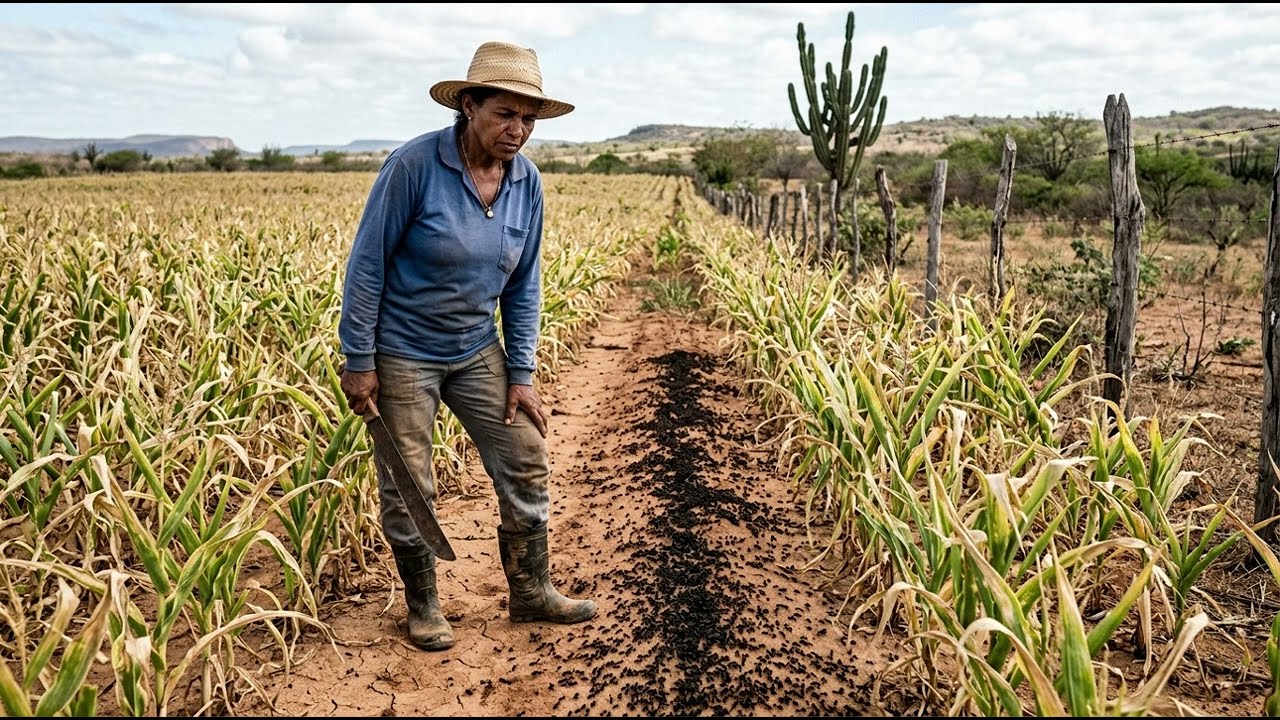
The sun was still low when Quitéria Nascimento stepped onto the red earth of the cornfield. It was the kind of morning that the Bahian countryside offers only a few times a year, with the cool air scratching the skin before the heat descends upon the caatinga, making everything burn. She had left the house without having breakfast.
When something in the field caught her attention at night, she couldn’t sleep well. And when she couldn’t sleep well, she woke up before everyone else. The day before, during her last walk around the property before dusk, she had noticed something different near the
oldest part of the cornfield, a sort of dark movement close to the ground between the rows of plants. At first, she thought it was a shadow. Then she thought it was fatigue, but when she got closer and saw it move, she realized it was neither. Now, as the
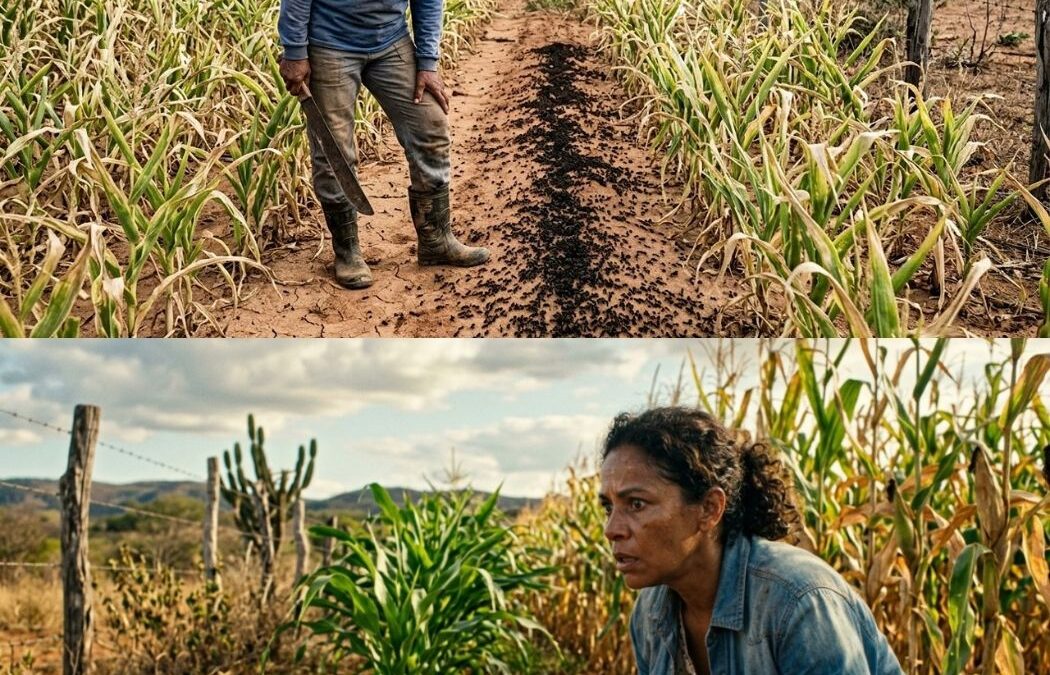
day slowly brightened behind the mandacarus, she stopped about 20 meters from the first rows and stood still. The strip was there. It was a dark, living stain that cut through the cornfield lengthwise, starting near the old wooden fence and extending for about 40 meters toward the pond. From a
distance, it looked as if someone had spilled something on the ground. Up close, it was worse. They were ants— not a few, not many. There were thousands of them, so packed together that the ground in that section seemed to pulse. Quitéria didn’t move. She was 46 years old and had spent most of
them walking through plantations. She had seen anthills, she had seen infestations, she had seen crops destroyed overnight when the farmer missed the right moment. But what was in front of her didn’t look like any of those things, because ants that attack
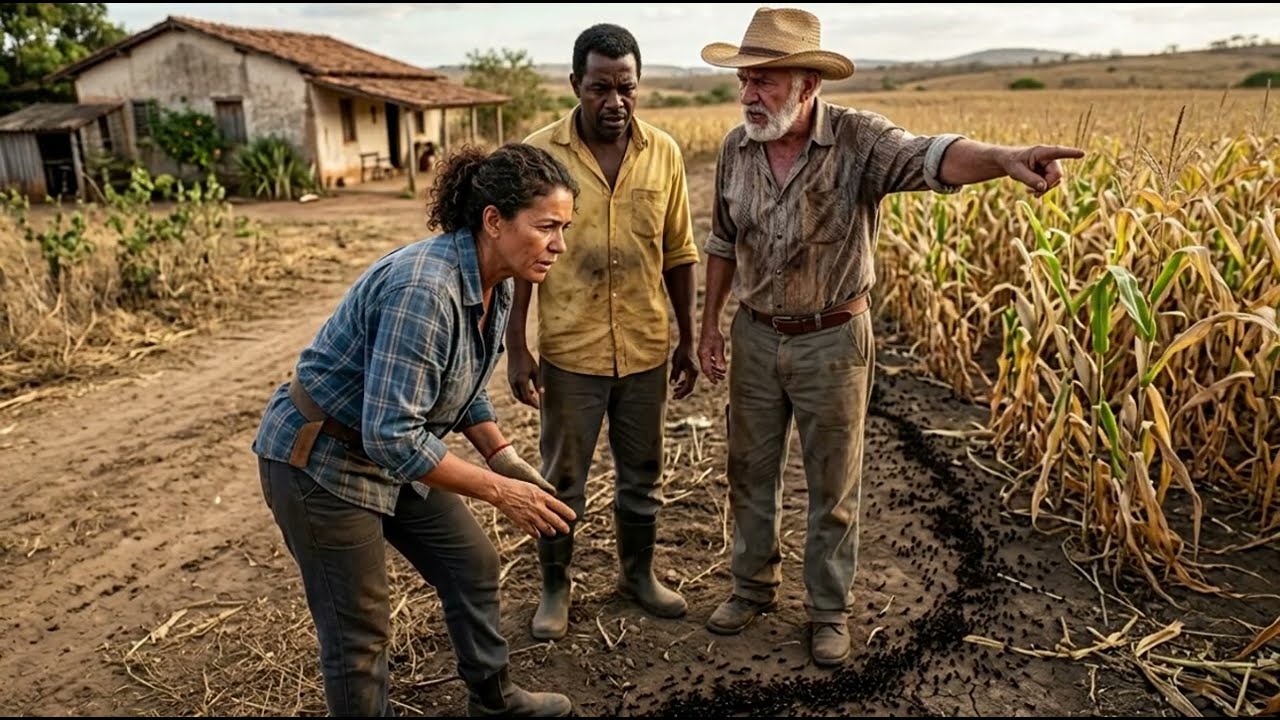
plants have no limits. They go where there is food, they spread out. They occupy everything they can. Those were not doing that. Those were following a line. Quitéria walked slowly to the side, without entering the plantation, keeping her distance. The strip of ants
didn’t go past the rows of corn on the right. It stopped there as if there were an invisible wall. On the other side, the plants were upright, leaves open, looking like they had grown without any issues. She walked another 10 meters or so and did the same on the left side. The result was identical.
The concentration of ants respected a very specific strip of the plantation and ignored the rest. She crouched down and stared at the ground. The ants were moving in two directions. Some were heading toward the fence. Others were returning from there, carrying pieces of plant matter. They came and went
with that tiny haste that ants have. As if they knew exactly where they were going and why. Quitéria pulled a piece of thin twine from her skirt pocket that she always carried to mark spots in the field. She tied it to a stake she had driven into the ground near the fence some years ago to measure the
ground level after the rain. On the other side of the path, she tied it to another, newer stake. She stood looking at the two points and the imaginary line between them. The concentration of ants began exactly there. She took out the battered notebook she carried in her pocket and noted the time, the
direction of movement, and the approximate width of the path. She wrote in small, firm letters, like someone recording something before someone tries to convince her that she saw nothing. When she returned home, Januário Batista was already on the porch. Januário was 63 and had the furrowed brow of a man who spent his
life under the sun without a hat for the first 40 years, and then with one for the next 20, when the doctor warned him that his skin was paying the price. He had owned the property for over 30 years. He had inherited land with problems from his father and turned it into a farm with fewer problems, which
in his mind was the same thing as a victory. Two bad harvests in a row had affected him in a way he wouldn’t openly admit, but which showed in the way he pursed his lips when someone mentioned costs. Did you go look at the ants? Quitéria stopped at the edge of the porch. I did. And? It isn’t what
Raimundo is saying. Januário took a sip of coffee. Raimundo is saying there’s an infestation. There are a lot of ants, yes, but it isn’t an infestation the way he thinks it is. She opened the notebook and showed him the sketch she had made. It’s all concentrated in a single strip. Outside of that strip, the plants are normal.
Ants that destroy crops don’t work like that. They go wherever there is food. These ones are following something on the ground. Januário looked at the sketch, then looked at her. Quitéria, I don’t have time to wait for you to figure out what’s going on inside the ants ‘heads. If that spreads to the
rest of the plantation, I lose the harvest. I know that. So the solution is: “Give me one day,” she said without raising her voice. That was her way. She didn’t yell, she didn’t argue, she said what needed to be said with the same calm as someone reading the weather in the sky. One day for me to
understand what is happening there. If I don’t have an answer by tomorrow morning, you do whatever you think is best. Januário stayed silent for a moment. Then he blew on his coffee and said: “Until tomorrow morning.”
Raimundo Alves arrived later, when the sun was already high. He was a 51- year-old man, broad-shouldered, with the hands of someone who repairs tractors, thirty years without gloves and without complaint. He had a practical way of seeing any situation that Quitéria respected in the field and found problematic when the
situation required patience. “We need to apply the product today,” he said, bluntly, standing at the edge of the cornfield, arms crossed. “If we leave it another day, they’ll reach the other rows.””They’ve been in this strip for at least two days and haven’t gotten anywhere.” Quitéria replied without
taking her eyes off the plants. “How do you know?””I know.” She pointed to the rows beside them. “Look over here.””Do you see any ants?” Raimundo looked. He didn’t answer. “Januário gave me until tomorrow.””Tomorrow you apply the product.””If I haven’t discovered anything.” Raimundo stayed a moment
longer, then turned his back and walked away. He wasn’t a man to argue twice. Either the decision was his, or he let it slide. That day, he let it slide. Quitéria stayed another hour observing . Then she went back to the tool shed, grabbed the hoe, the lantern, and told her nephew she would return to the
cornfield after dinner. Mateus Nascimento was 27 and had arrived at the farm two months earlier, coming from Feira de Santana after a construction job that hadn’t worked out . He was Quitéria’s nephew on his mother’s side, curious like young
people who grow up without much and learn to observe what others waste. He knew almost nothing about agriculture in a technical sense, but he had good hands and the willingness of someone who wants to learn without showing off. “What are we going to do in the cornfield at night?” he asked, helping to clean the tools, “see how the ants
behave when no one is watching.” Mateus didn’t ask anything else. That afternoon, as the heat gave way to the dry wind running through the scrubland at the end of the day, Quitéria sat on the porch with her notebook on her lap, rereading the notes she had made in the morning. She added some observations,
drew the position of the stakes, marked where the ant trail began in relation to the pond and the fence. There was something about that alignment that bothered her. The trail wasn’t following the rows of corn. It was cutting across them diagonally, at a very slight, almost imperceptible angle
, but one that became clear when you marked the extreme points. and diagonal on that terrain meant that something underground was driving that movement. She closed her notebook and kept looking at the caatinga until the sun disappeared behind the twisted branches of the Jurema tree. Afterward, she had
dinner, waited for night to fall, and went to get the lantern. Night in the Bahian countryside has a silence that city people usually call peace, but that country folk know isn’t quite that . It is a silence full of sound.
Crickets, frogs near the pond, the wind passing through the dry branches of the caatinga. Every so often, the movement of some small animal in the brush, but no voices, no motors, no rush. Quitéria lit the lantern near the shed and waited for Mateus to finish putting
on his second boot. “How long are we going to stay there?”, he asked. “As long as it takes. They walked along the dirt road that separated the house from the cornfield. The lantern light made shadows flicker on the mandacaru cacti scattered along the side of the path.
It was a night without a bright moon, with stars spread across the dry caatinga sky, the kind of sky that only appears when there isn’t a single cloud and the air is clear in a way only the countryside has. When they reached the edge of the plantation, Quitéria stopped and listened for a few seconds before entering. Why do you do that?
Mateus asked in a low voice to know if there’s anything different before lighting the way. He stayed quiet. After a moment, she raised the lantern and walked slowly into the corridor between the rows of corn. The smell of the plantation at night is different, heavier. The soil’s moisture rises
after the sun goes away and the plants respond in a way you can’t perceive during the day. The ants were there. Mateus gasped when he saw them. Even at night, with the dim light of the lantern, you could see the movement.
The ground in that stretch seemed to teem slowly, without noise, with that impressive organization that ants have and that bothers people, precisely because it looks too much like human work.” They don’t even stop at night “, he said.” Ants, they don’t stop! ” Quitéria walked down slowly along the
edge of the strip, the lantern held low , looking at the ground. But notice what they are carrying. Mateus crouched down beside her. The ants returning toward the fence were bringing small pieces of plant material, thin roots, fibers, something dark and damp that
looked like a mixture of earth and organic matter. Where is this from? He asked. That is what I need to find out. They followed the direction opposite to the ants’ movement, heading toward where they were coming from. The row narrowed slightly as they advanced
toward the oldest part of the cornfield , near an area locals simply called” the bottom, “because it was on the lower side of the property, where the ground sloped gently toward the pond. That was where the trails disappeared.
Quitéria stopped and stared at the ground for several seconds. The ants arriving from the fence side dived into the earth at a certain point, as if the ground swallowed them, and those going the opposite way emerged from the same spot, as if they were sprouting.” Is there an anthill here? “Mateus asked.”
Maybe, “but she didn’t seem convinced. She kept watching the entry and exit point.” Get the hoe. “Mateus grabbed the hoe he had been carrying over his shoulder and handed it to her. Quitéria didn’t use it with force. She carefully pressed the tip into the dirt , moved a thin layer of topsoil aside,
and tilted the lantern to illuminate the result. The earth underneath was dark. Not the dark color of good soil with organic matter. Dark the way soil gets when it’s been damp for a long time. She touched it with her fingertips; it was cold, almost soaked.
” It’s wet here, “Mateus said, touching it next to her. How many days has it been since it rained? he thought. Six days, at least. Quitéria stood up and walked about 5 meters ahead. Still within the same row, she made the same movement with the hoe. This time the earth was dry, reddish dust, hard,
compacted, the kind that rain takes a long time to penetrate. She went a meter forward—dry; she went back to the previous spot—damp; she stood looking at both points on the ground for a long time.” The soil is damp here , but dry there, “Mateus said, not
exactly as a question, but as if helping his own reasoning take shape.” Five meters apart, “she confirmed,” in the same type of soil, under the same conditions, with the same crop on top.
“She rested the hoe and stood holding the handle with both hands, looking at the row.” Moisture that doesn’t dry in six days isn’t coming from rain, it’s coming from something deeper. “Mateus remained silent.” Mark it here, “she said, pointing to the dampest spot. He took a small stake from his pocket and
drove it into the ground. She noted it in her notebook. They continued walking along the edge of the row, testing the soil meter by meter. Quitéria kept noting where the ground was damp and where it was dry. Within about 20 meters of walking, she had marked seven damp spots. When she connected the dots
in her notebook, they formed an irregular but clearly directed line, moving from the back toward the middle of the property.” Does this make any sense? “Mateus said, looking at the notebook.” It does. “She pointed toward the reservoir, which was about 100 meters away.” The water from the reservoir can’t be reaching here
because its level is low. So, the moisture is coming from somewhere else. “” From where? “She didn’t answer right away. She closed her notebook and stared into the darkness toward the back of the property.” Tomorrow we’ll know more, “she said. They returned home shortly before midnight. The sky
was still full of stars. The day’s heat had completely faded, and the air had that dry chill that the Bahian countryside produces on winter dawns, even when it feels like summer will never truly end. Quitéria stayed on the porch for another half hour before going inside, watching the cornfield in
the dark. From that distance, you couldn’t see anything, just the dark mass of plants and, further back, the pointed silhouettes of the cacti. But she kept thinking about the line she had drawn in her notebook, a line of moisture that shouldn’t exist. The next morning, she was in the cornfield
before the sun had finished rising, this time with enough light to see what she couldn’t see the night before. She walked slowly along the strip, paying attention not to the ants, but to the plants themselves. What she saw changed her hypothesis once again. On the left side of the strip, the corn was growing
well. Open leaves, strong coloring, firm stalks. On the right side, within the strip, the plants were different— not destroyed, not dead, but different. Some had slightly wider leaves, others had stalks with a more intense shade of
green, almost too dark, and a few showed growth that seemed larger than the surrounding plants, as if they had received more than they needed. Uneven growth in a uniform crop. Quitéria leaned over the base of one of the plants with irregular growth. She
examined where the stalk emerged from the soil. There was no sign of pests, no visible tunnels. The plant itself seemed healthy, but the soil around it was more compacted than that of the neighboring plants. With a slightly different color. She dug a little with her hoe. The soil 10 cm deep was damp
—more than damp. There was a patch of soil with constant moisture that made no sense for an area that hadn’t seen rain in six days. The ants weren’t destroying the corn. They were taking advantage of something that was already happening in that stretch of land before they arrived. Quitéria stayed
on her knees for a long time, her hands dirty with soil, looking at the spots she had marked with stakes: the damp strip, the concentration of ants, the different behavior of the plants. Everything in the same place, all following the same irregular path that cut across the field diagonally. She
needed to know what was under that earth, and for that, she needed to talk to someone who knew the property longer than anyone else still living around there. Dona Zefinha lived in a wattle-and-daub house with a colonial tile roof, about 2 km from Januário’s farm, in one of the last houses before
the dirt road disappeared into a bend leading up into the densest part of the scrubland. She was 72 and had spent most of them in that same house: first with her father, then her husband, then alone. She had never left the Bahian interior for more than a week, not
because she couldn’t, but because she never wanted to. Dona Zefinha’s memory was the kind of thing the younger residents of the region treated with a mix of respect and disbelief. She remembered things that had happened before most of them were born. She
remembered names, dates, and details that nobody had written down, because at the time, it didn’t seem important to note them. Quitéria arrived in the morning, even before the midday heat, with a bag of cassava flour she had set aside from the farm’s stock, as a way not to show up empty-handed. Dona
Zefinha was sitting outside the house, under a juazeiro tree that provided enough shade for two people. She was sewing something that looked like a patch on an already heavily patched piece of clothing. Quitéria, she didn’t lift her head. Sit here.
Quitéria placed the flour next to the old woman’s chair and sat on a low stool that was leaning against the wall . She stayed silent for a moment, which was the right way to start a conversation with Dona Zefinha. She didn’t like people who showed up talking. After about two minutes, the old woman folded the patch and looked
at her. What’s going on at Januário’s farm? Ants in one part of the cornfield . There are ants all over the farm. Not these ones. These are in one specific stretch, following a line. And the soil in that area has been damp for at least six days without rain. Dona Zefinha stared at her with those dark eyes that
always seemed to be evaluating something invisible. And what did you come to ask me? If you know what’s under that part of the farm? The old woman didn’t answer immediately. She stared at the Juazeiro tree for a moment, as if the answer were hanging from one of its branches. That area at
the back of the farm, she said slowly, we didn’t call it Januário’s farm when I was young. We called it old Eufrágio’s land, Januário’s grandfather or something like that. Old folks. Quitéria waited. In old Eufrágio’s time. That back part was different. It was rock and grass. There
was no corn. And there was something the old man had ordered built, I don’t know what year, but I was small and my mother told me because she had seen it. The old woman paused, picked up a glass of water that was on the floor beside her, and took a slow sip. It was a kind of stone channel, not big, a long
trench that ran along the lower part of the land. My mother used to say that in dry years, the water from the higher rocks would flow through that channel. And go into a reservoir the old man had ordered to be dug. Quitéria felt something click in the back of the reasoning she had been building: a
stone channel, of carved stone, that the old man had ordered laid right into the ground, covered with dirt so it wouldn’t break or clog with leaves. My mother said it was the greatest work that property ever had. And what happened to it? The old woman shrugged her shoulders. The old man died. His
children didn’t keep it up. By the time my husband worked around those parts, we didn’t talk about it anymore. I think it was filled in when they started planting corn in the back, or covered up, I don’t know. Quitéria was silent for a moment. Do you remember where that channel ran? More or less.
The old woman closed her eyes for a second. It started up high, near those big rocks that look like the backs of oxen. And it went down crooked. It wasn’t a straight line. It followed the natural slope of the land until it reached the back of the property.
Diagonally, Dona Zefinha opened her eyes and looked at her with an expression Quitéria couldn’t quite define. Diagonally. Yes. Why do you ask like that? Because the trail of ants is diagonal too. The old woman remained quiet for a long moment. Then she said
in a lower voice:” Then the channel is still there. “Quitéria returned to the farm with her head full of thoughts. Januário was in the shed with Raimundo when she arrived and told them what she had discovered. Raimundo listened with his arms crossed, wearing the expression of someone tolerating an
explanation they find unnecessarily long. A buried stone gutter. Januário repeated, conducting moisture through the lower part of the land. That’s why the soil in that area is wet despite it not raining. There is water passing underneath. Januário looked at her, then looked at Raimundo. Doctor,
does that not change the ant problem? Raimundo said:” If there’s water below, great, but there are still a bunch of ants on top destroying the corn. “” The corn isn’t destroyed, ” Quitéria said. It’s growing differently because it’s getting different moisture, and the ants aren’t destroying anything. They are taking
advantage of the conditions the subsoil is offering, taking advantage, attacking. It’s all the same thing to the crop owner. Januário raised his hand, a simple gesture from someone who wants both to stop. Quitéria, if there is a stone gutter down there, what does that change? It changes everything. She opened her notebook and showed the
sketch of the strip with the moisture points. A buried gutter that went decades without maintenance could have blocked parts, open parts, parts where water is no longer following the right path. This means moisture could be accumulating at some point below the cornfield. If a heavy rain comes, that
water dammed up below will look for an exit, and when it finds one, it will take the path of least resistance: the looser soil, right where the gutter is. Januário stayed quiet. Raimundo uncrossed his arms. Are you saying a trench could open up in the middle of
the cornfield? I’m saying if we don’t know what’s down there, we have no way of knowing what will happen in the next rain. There was a long silence. Januário tapped his palm on the edge of the shed. Not with anger, but with the manner of someone processing information they didn’t want to receive. How much time do you
need to confirm this? One afternoon; Mateus and I will follow the moisture strip and see if we can find any trace of the gutter. And the ants? The ants will stay exactly where they are. They aren’t reaching the other rows; they’re staying in their gutter.
Raimundo gave a short laugh. It wasn’t a mocking laugh; it was the laugh of someone hearing a line that, in spite of themselves, they find good. Januário gave an almost imperceptible nod. One afternoon, Quitéria. The afternoon was hot in the way that only the Bahian countryside can be, when the
sun hits mid-course and decides to make up for the day’s delay. Quitéria and Mateus went to the field with hoes, an old broom handle she used to measure depth, and the notebook with the moisture points marked. The idea was simple: follow the moisture line from one point to the next and try to find
some physical trace of the old trench. They didn’t need to dig a ditch; they needed confirmation—a stone at the right depth, an unnatural alignment, anything to show that Dona Zefinha wasn’t confusing memory with an old woman’s imagination. They started at
the wettest point, which was at the back of the property. Mateus dug with the hoe while Quitéria watched. The earth came out reddish for the first 20 cm, then it became darker. At 30 cm, the hoe met resistance.” There’s a stone, “Mateus said. Quitéria climbed
down beside him. She used her hands to clear the dirt from around the resistance. A smooth, flat surface appeared, reddish with stains of moisture. Was it not the kind of stone the Bahian soil usually leaves randomly near the surface? Those irregular fragments that farmers keep removing
from the ground year after year. It was a worked stone, flat on top, with the side cut at a right angle. They looked at each other.” Keep digging, “she said . As the earth was removed, the stone revealed more of its length. It wasn’t an isolated fragment; it was part of a
structure. They worked for almost an hour at that spot until they could see the extent of the piece. It was a long stone, about 60 cm long and 30 cm wide, with a slight curve in the center that formed something like a shallow channel , a stone gutter. Quitéria stared at
it for a long time without speaking. Mateus took a breath.” Is this what Dona Zefinha was talking about? “” Yes. “She touched the surface of the stone with her fingers. Damp, cold, as if water had been flowing through there for decades, without anyone knowing.”
Cover it back up. “” Let’s move further ahead. “They advanced about 15 meters, following the moisture line. They dug again to the same depth; the same smooth stone, the same curvature. The channel continued. They went another 15 meters. But at this point, the moisture
in the notebook was marked as absent. The soil was dry. They dug anyway, deeper. This time they found the stone, but this time it was different. There was a crack in the middle and the side was displaced, as if the ground had
shifted at some point and pushed the stone out of alignment. The curvature that formed the channel was obstructed by compacted sediment. The water flowing down the channel reached that blocked point and couldn’t go any further.” It’s clogged here, “Mateus said. So where does it go then?
Quitéria kept looking at the ground around the blocked point. She walked around it, testing the moisture with her fingers. About two meters to the side, the soil was moist again. It diverts. When it meets the blockage, the water seeps to the side and finds a path through the soil itself. That’s
bad. It depends. If the soil holds, it’s not that bad. But if the soil is loose at that spot, the seeping water might be creating a cavity underneath. She stared at the surface all around. Mateus, walk over that area there. He looked at her with an uncertain
expression, but obeyed. He walked slowly across the area she had pointed out. On the third step, the ground gave way slightly under his right foot. Not much, not enough to fall, but enough to feel there was some empty space below the surface. Mateus quickly stepped away. Is it hollow? He said,” It’s
hollow, “and noted it in his notebook. Then she stood still, looking at the cornfield that stretched from that point, calculating: The cavity was exactly under the stretch where the plants showed irregular growth. The water seeping through the gutter blockage was hollowing out the interior
of the soil. On top, the earth looked firm. Below, there was space. And what if it rained? If heavy rain came, the volume of water flowing down the gutter would be many times greater than what was passing through at that moment. The blockage wouldn’t hold, the water would
seek an outlet with force, and the cavity under the plants would be the path of least resistance. The cornfield could subside, not everywhere, but in that stretch where the gutter was blocked and the cavity was growing slowly, the ground could collapse at once, dragging the roots, knocking down
the plants, and opening a trench in the middle of the crop. And the rain was not a distant possibility. The sky over the caatinga had that milky color on the horizon that farmers in the countryside know well. The color that appears two or three days before a
storm. Quitéria closed the notebook.” Let’s go home, “she said.” I need to talk to Januário still today. “They covered the spots where they had dug and headed back quickly. Mateus carried the hoes. Itéria carried her notebook under her arm with the look of someone who had just understood a question they
didn’t know they were asking. Upon arrival, Januário was in the corral. She went straight there. We found the Cália. Januário dropped what he was doing and looked at her. It’s real. It is buried about 30 cm deep, following the diagonal I had marked.
And there is a blocked point where the gutter is cracked. At that point, the water is leaking to the side and carving out a cavity under the cornfield. She opened the notebook and pointed out the spots. Januário stared at the sketch in silence. Then he looked at the horizon, at that milky
color growing slowly. When do you think it will rain? Two days, three at most. What if a heavy rain comes before we solve this? She did not soften the answer. The part of the cornfield above this cavity could open up. Januário nodded slowly. His way of processing
bad news without showing panic. What do you need me to do? Raimundo heard Ter explain it for the second time with the expression of someone hearing the same argument in different languages. It wasn’t ill will. It was his way of processing anything that didn’t fit
into the categories he knew. For Raimundo, farming problems had farming solutions. Pests are eliminated, compacted soil is turned, broken machines are fixed or replaced. What Quitéria was describing was different, and the different to him always had a
taste of unnecessary complication.” So, you want us to stop cultivating that section? “He said:” No, immediately. First we need to understand how far the cavity goes. That is a waste of money. It is prevention of a greater loss. ” She pointed to the sketch in the notebook. Raimundo, if the rain comes
first and the ground gives way, you won’t just lose those rows, you’ll lose the machinery that tries to pass over them later, because the ground will be unstable around the entire perimeter of the cavity. Raimundo stayed quiet. For a man who spent his life taking care of machines, the idea of equipment sinking into hollow ground
was one of the worst images possible. How long to fix it? It depends on what we find. If the gutter blockage is localized, it might be possible to fix it without much work, but it must be done before the rain. Januário was leaning against the shed wall, listening to everything. He remained
silent for a moment after Quitéria stopped speaking. Then he said:” Raimundo, can you and Mateus open an excavation at the point she marked? “I can. Then do it first thing tomorrow morning. Quitéria goes with him. Raimundo sensed she was unenthusiastic, but not resistant. That was his way,
too. Once a decision was made, he executed it. That night, Quitéria stayed on the porch later than usual. The milky color on the horizon had grown and now covered much of the west. The wind had shifted slightly, which in the Bahian backcountry sometimes meant
nothing, and sometimes meant that rain was coming faster than it seemed. She thought of Dona Zefinha, of the story of the gutter old Eufrágio had ordered built. She imagined a man from a time she never lived, looking at that land the same way she had, trying to
understand how to make the water work for the land instead of against it. The gutter hadn’t been built on a whim, it had been built because that stretch of land had a specific logic, a way of behaving with the rain that the old man had understood and that everyone who
came after simply buried without knowing what they were covering. And the land was now paying it back with ants, with misplaced moisture, with plants growing differently. The land was giving a warning. She took her notebook and began rereading her notes
from the last week. Every damp spot, every place she had dug, the length of the gutter she had managed to confirm the position of the cavity. One important piece of information was missing: where the gutter ended. Dona Zefinha had said it ran from the top of the property, from the rocks that
looked like a bull’s back, to a reservoir the old man had ordered dug at the bottom. But Quitéria didn’t know where that reservoir was, if it still existed, was buried, or had been destroyed. And if the gutter was still carrying water from some source in the high parts of the land, then a constant
amount of moisture had been entering the system for decades, without a proper outlet. The next morning, before going to the field with Raimundo and Mateus, she made a stop, returning to Dona Zefinha’s house. The old woman was in the same place under the juazeiro tree, but this time without her needlework. She had her eyes closed
and Quitéria thought for a second that she had arrived too early.” Go ahead, ” Dona Zefinha said without opening her eyes. I’m not sleeping. Do you remember where the reservoir was, the one old Eufrágio had ordered dug at the bottom of the property? The old woman opened her eyes, staring at her. Why do you
want to know about the reservoir? Because if the gutter is still active, water is coming from somewhere and I need to know where it goes when it reaches the bottom. Dona Zefinha remained quiet for a moment, then stood up slowly, leaning on the edge of her chair, and went to the side wall of the house. There was a prickly pear cactus
there, with broad leaves and thick roots that slightly raised the earth around it. The old woman stood beside the cactus, looking at the terrain that stretched toward Januário’s farm. The reservoir was near the pond, she said:” No, in the pond, near it, on the side the sun hits first in the morning.
My mother used to say the old man built them both at the same time so the overflow from the reservoir would spill into the pond. “Quitéria kept looking in the direction the old woman had pointed. Januário’s pond was in the east corner of the property, on the side the sun hit first in the morning.”
Thank you, Dona Zefinha. “” Watch out for the rain, “the old woman said, returning to her chair.” When that color appears in the western sky, it won’t be long. “Quitéria looked at the sky as she walked back to the farm. Yesterday’s milky hue had turned into something denser, a sort of yellowish
whiteness on the horizon that country farmers don’t need any instruments to decipher. The rain was coming, maybe not in two days, maybe in one. When she reached the shed, Raimundo and Mateus already had the tools laid out. She didn’t waste any time.” We’re going
to need more people today, “she said. Raimundo raised an eyebrow.” Why? “” Because we don’t have time to do this slowly. “Four people went to the field. Raimundo brought a laborer who lived in a house on the edge of the property and helped with general chores. A man named Cosme, who had arrived in the region
about 5 years ago and had a reputation for working non-stop when needed. Mateus completed the group. Quitéria did not pick up a hoe. She stayed outside the marked area, observing and indicating where to dig. It was the work she did best, not out of laziness, but out of necessity. When you are
inside the excavation, you lose the perspective of the whole. When you are outside, you can see what others do not . They started at the point where Mateus had felt the ground give way. Raimundo dug with care, differently than Quitéria had expected. There was a respect for the subsoil in him that
didn’t show in the way he spoke about the matter, but was evident when he had a tool in hand and earth to work. Every movement was calculated. He didn’t force where he shouldn’t. He felt the resistance before deciding the direction. At a hand’s depth, Cosme’s
hoe hit stone. Raimundo went to his side. Together they cleared the dirt away. The channel looked longer than in the spots Quitéria and Mateus had dug before. Here, the structure was more intact. The side stones were still in place, forming a canal about six inches
wide and deep enough to carry a reasonable volume of water. And the channel was wet, not just damp like in the other spots. Wet, with a thin layer of water running very slowly, almost imperceptibly, but it was there.
Raimundo stared at it for a moment, then looked at Quitéria.” It’s active, “he said. She felt it without showing any satisfaction.” Move another 20 meters toward the reservoir and open another spot. “They opened it. The channel continued, this time with more water. And the stone at the bottom of
the canal had a different color, darker , the way it gets when water flows in the same place for a long time. Cosm crouched inside the excavation, running his hand over the stone at the bottom of the canal, with an expression Quitéria recognized. It was the look of someone touching something ancient
and feeling, even without being able to explain it, that it was made by human hands in a time that won’t return. There was a kind of precision in those channel stones that nature doesn’t produce. The corners were too angular, the alignment too regular. Someone had
chosen each stone with care. They had laid them one over the other with the intention that they would stay there for decades, and they had. What tool did they use to cut these stones like this? Cosm asked no one in particular.
Chisel and hammer, probably. Raimundo replied without taking his eyes off the canal.” Slow work, slow and good, “Cosm said. Quitéria heard that exchange and said nothing, but felt something within her settle. The confirmation that what Dona Zefinha had described wasn’t an
old woman’s embellished memory; it was simple engineering, made with what was available, adapted to the specific terrain of that property, but engineering nonetheless. She walked further along the marked strip, testing the ground with her feet as she went.
There was a difference in firmness between the section of the intact channel and the stretch where the crack had blocked the flow. In the intact section, the earth under her feet had a discreet solidity. The kind of solidity that comes from well-drained subsoil, which doesn’t accumulate moisture for too long. In the blocked section, the
ground gave back a different lightness, almost like walking on a very thin mattress. The ground was saturated below, and the cavity she had identified the day before had grown after the pressure from the previous night, when rain had begun to accumulate. Quitéria called Raimundo.
Before you go to the reservoir, open a spot here beside the crack. No, on top, to the side. Raimundo came with the hoe , digging carefully. 30 centimeters deep revealed something she had suspected but not confirmed. Beside the blocked point, where water had diverted from the canal into the soil, there was
a layer of earth that had changed in color and consistency. It was lighter, more granular, the kind water creates when it circulates through soil long enough to wash away fine particles and leave only the coarse ones. It was the trace of a parallel canal that hadn’t been built by anyone. Water had built
it alone, over decades, its own alternative path within the Earth.” The water went away through here, “Raimundo said, looking at the layer.” A long time ago, “Quitéria confirmed. This alternative canal has been here for years, which is why the cavity is so large. It wasn’t just yesterday’s rain
that did this. It was years of water looking for an exit along the wrong path. Raimundo stood beside the excavation with his arms at his sides, which for him was the equivalent of standing in contemplative silence. Then he said,” We were planting corn on top of an invisible ditch. “Exactly. And
the ants. The ants found the humidity that this alternative canal creates. Soil with constant humidity is favorable territory for many species. They weren’t there by accident. They were there because the subsoil was offering exactly what they needed.
Raimundo stood for another moment looking at the alternative canal. Then he picked up the hoe. I’m going to the reservoir. Quitéria walked to the edge of the reservoir and stood looking at the stretch of bank on the east side. The vegetation there was different, denser. Plants that like constant
humidity, growing amidst species that generally live on drier land. She knew that pattern. It was vegetation that felt the water nearby. She borrowed a hoe from Mateus and dug it herself on the edge of the bank, about 3 meters from the reservoir. 15 centimeters of earth. At 20 to 30 centimeters, she
found a stone that wasn’t a natural outcropping. It was the edge of a larger structure. The deposit wasn’t completely destroyed; it was covered. The Earth had advanced over it over decades, reducing what had been a reservoir to a partially clogged
chamber, but it still functioned. The water arriving through the gutter would flow in, overflow into the reservoir through the wall that had collapsed at some point, and the excess that could no longer drain would remain inside the chamber, creating pressure on the surrounding soil. And the surrounding
soil was precisely the section of the cornfield with the sinkhole. Quitéria stood there for a long time, looking at the edge of the buried structure. Old Eufrágio had built an entire system. A channel up high to catch water from the rocks, a gutter to lead it to the bottom, a basin to store it, and
drainage to the reservoir. It was a rainwater harvesting system that worked as long as someone knew it existed and kept it clear. When that knowledge died with the elders, the system continued to exist, but without maintenance. The gutter was blocked at one point. The
reservoir was partially clogged. The water that once flowed in a controlled manner began to seep where it shouldn’t have. And the result, decades later, was a cavity under the cornfield and a stretch of unstable land waiting for the first heavy rain to reveal everything that had been hidden. Mateus
had watched the excavation of the reservoir in silence. When the edge of the chamber became visible enough to understand what it was, he crouched down and examined the stone that formed the sidewall. It was a different stone than those in the gutter, larger, flatter, set in mud mortar that had
hardened to the point of seeming like part of the stone itself. How old is this? he asked. Dona Zefinha said her mother was young when old Eufrágio built it. She is 72 years old. Her mother was older, probably 90, 100 years. Mateus kept looking at the stone
. 100 years. Built to last. And it’s still lasting. Quitéria didn’t answer, but it was true. The system had survived decades of abandonment, layers of dirt thrown over it, years of crops planted without knowing there was another invisible crop working
underneath. It had survived all of that and was still conducting water. It was still creating the conditions someone had planned a century earlier. The difference is that now it was doing it in the wrong place, because the right path had been blocked. Raimundo arrived
beside them and kept looking at the reservoir chamber. For a long moment, he said nothing. Then he turned to Quitéria with an expression she rarely saw on him, a mix of respect and bewilderment that happens when a practical person encounters something that goes beyond the practical
categories they know. What a job! He finally said. It wasn’t a critique, it was recognition. The man who did this understood water. She agreed. The problem is that no one after him understood. Raimundo stood for another moment looking at the storage shed.
Then he lifted his eyes to the line the cornfield formed in the back, the rows of corn, casting long shadows late in the afternoon. There was something in that image he was processing, which Quitéria noticed by the way he stayed quiet longer than usual.” Quitéria, ” he finally said.” Yes, you were right
from the beginning. “She didn’t answer immediately, not because she wanted to hang on to the moment out of vanity, but because those words from Raimundo carried a specific weight she wanted to let settle properly before saying anything back.” The soil was right, ”
she said at last.” I only listened to what it was saying. “Raimundo nodded once, then picked up the hoe and went to cover the excavated spots that needed protecting before nightfall. Cosmi followed him. Mateus stayed by Quitéria’s side for another moment.”
What now? “He asked.” Now I need to convince Januário that the solution isn’t to destroy this place, but to restore it. “The sun was going down. When they walked back to the house, Quitéria moved slowly. As she always did when she had much to think about.
The reddish dirt road was still damp from the humidity that had risen during the day, and the footprints she left were deeper than usual. All around, the *caatinga*prepared for the night the way it does in that backcountry. The crickets began, the wind cooled all at
once, and the mandacaru cacti grew sharper outlines against the darkening sky. She thought of old Eufrágio, a man she had never seen and whose name she only knew from Dona Zefinha’s memories, a man who had looked at this same land in another time and had seen
what she was seeing now: the logic of the water, the natural slope of the soil, the spots where the terrain needed help to behave well, and he had done something about it with the tools he had, with the knowledge he had gathered, with the patience of someone who builds for later, not just for now.
That was an inheritance, not of blood, not of papers, but of knowledge buried in the soil that needed someone willing to dig to find it. Quitéria entered the house, lit the oil lamp, and went to prepare what she would say to Januário. The rain arrived sooner than expected. That night, shortly before
midnight, the sky, which had been milky and still all day, made that movement that farmers in the backcountry recognize with their stomachs before they recognize it with their eyes. The wind stopped completely. The silence of the caatinga grew deeper and then, without any gradual warning, the rain came all at once. It wasn’t a drizzle,
it was caatinga rain—dense and heavy —the kind the dry earth absorbs for the first few minutes and then simply can’t take anymore, letting the water run across the surface toward the lowest point of the land. In the farmhouse, Januário was the first to wake up with the noise on the roof.
Quitéria was already awake. She had been lying there listening to the silence grow thicker and had recognized what it meant an hour before the rain began. There was something in the silence of the caatinga before a rain that those who grew up there learn to decipher early on. It is not an absence
of sound. It is a different suspension, as if the animals, plants, insects, and the very air knew something was coming and decided to pause and wait. The crickets stop. Then the wind vanishes all at once, without tapering off gradually. It simply leaves like
someone walking out of a room without saying goodbye. And then the air becomes heavy in a way that has nothing to do with temperature; it has to do with pressure. A pressure you feel on your skin before you can even name it.
Quitéria had recognized that pressure at around 11 at night. She had lain there for another hour waiting, listening to the silence deepen, thinking about the blocked point in the gutter and the cavity that had grown beneath the cornfield. She had done the calculations more than once in her head . If the rain were light, the flow
through the gutter would be insufficient to pressure the blockage, and the situation would remain the same or slightly worse, but manageable. If the rain were moderate, there was a chance the blockage might partially give way, releasing some flow, which could be good or bad, depending on how
much earth had loosened inside the cavity. If the rain were heavy, the most likely scenario was that the blockage wouldn’t withstand the accumulated pressure and the water would find its exit through the path it had carved over years, the alternative channel running straight into the cavity. When the noise on the roof
became intense, she got up, put on her sandals, and went to the window. It was too dark to see the cornfield, but she could imagine what was happening there. Water descending from the high ground, reaching the channel, hitting the blocked point in the cracked gutter, searching for an exit, seeping through
the loose soil, pressing on the cavity from below. Januário appeared on the porch with a lamp. It’s heavy. He said, ” I know. “She kept staring into the darkness. There’s nothing to be done now. We need to wait for daylight.
You’re worried. She didn’t answer. Not because she was being evasive, but because the answer was too obvious to need words. Januário stood beside her for a moment. He had that way of standing still that men of his generation have. The way of someone who learned that some situations don’t need
talk. He had grown up on a property where his father didn’t explain much. Decisions were made, executed, and evaluated later. Talking about what was happening while it was happening was a habit he had developed late, and still in moderation. How long will this rain
last? he asked after a while. Two hours , maybe less. And the cornfield? Tomorrow morning we’ll see. He nodded, went to get more coffee. The two of them stayed on the porch while the rain fell. Raimundo appeared after about 20 minutes, with the same expression of someone who wakes up with their brain
already running at full speed. The three of them stayed quiet, listening to the rain hit the tile roof and run into the wooden gutters at the corners of the porch. At one point, Januário said:” If I had let Raimundo apply the product on the first day, what would have happened? “Quitéria paused for a
moment, wondering if he wanted a truthful answer or an answer that would make him feel less bothered by his own delay in accepting what she was saying. Then she decided that Januário was the type of man who preferred the truth.
Would the product have reduced the number of ants? Yes. The corn in that strip would have had less movement on top, but the subsoil would remain exactly the same. The cavity would keep growing, the drainage ditch would remain blocked. The only difference is that you would no longer have the
visual warning that there was a problem . It would look like everything was fine until the day the ground gave way. Januário kept looking at the rain in the darkness of the porch. Worse than it is now, he said, much worse, because now you know what is down there. If you had eliminated the ants without investigating, you would have
discovered the problem halfway through the next harvest, when the ground gave way with the machinery on top. There is a kind of silence that is not discomfort, it is processing. Januário remained in this silence for a considerable time, while the rain hit the roof, and the lamp he had placed on
the edge of the porch swayed slightly in the wind that blew underneath. Raimundo was leaning against the porch column, with his arms crossed. After a moment, without taking his eyes off the rain, he said:” I had never thought of ants as a sign of anything. “It was always a plague. Sometimes it is a
plague.” Quiteria said. This time it wasn’t. How did you know the difference ? She thought about the question. It was an honest question, asked the way Raimundo asked honest questions, without flourish and without expectation of a complicated answer. By
the pattern, she said, ants destroying crops spread out, following the food, not a line. When I saw that those were following a very specific track and ignoring everything around them, I knew they were responding to something in the ground, not looking for food in the cornfield. Raimundo was quiet for a
moment. Then, who did you learn that from? From the cornfield. He didn’t laugh. He kept looking at the rain as if he were tucking that away somewhere useful. The rain lasted a little over two hours. In the Bahian interior, heavy rains rarely last longer than that. They come with force, discharge,
and leave, lingering with the smell of wet earth for hours afterward. When it stopped, the sky began to clear on the east side. Not all at once, slowly, as is the custom in the interior. First, the darkness lost its depth, then the shapes of the cacti appeared against the gray background. Then the cornfield
began to take shape. Quiteria went to the field before there was enough light to see well. She took the lamp. The dirt road from the house to the cornfield had puddles formed where the ground dipped slightly. She stepped around them, without straying much from the path, accustomed to those puddles
for years. The smell of the wet earth was intense and good, one of the smells she associated with the beginning of things, not the end. When you live in a place where rain is not a guarantee, the smell of it on the earth has a weight that no city can reproduce. But that night, the smell didn’t just bring beginnings. It also brought the anxiety
of not knowing what the water had done down there. While everyone else was on the porch waiting. She followed the edge of the marked strip. The ground was soaked throughout the property, as was to be expected. But when she reached the section where she had confirmed the presence of the cavity,
the lamp revealed something she had tried to calculate mentally, but seeing it in practice was worse than the math. The corn in that section was leaning— not all of it, not catastrophically, but the rows growing exactly over the cavity point were slightly out of plumb
. The roots were still in the soil, the plants were still standing, but the earth supporting them had given way a few centimeters below the surface, and that minimal movement had been enough to throw the plants out of alignment.
Quitéria examined the ground around them. The surface looked different. There was a subtle dip, about 2 cm below the level of the surrounding soil , small but visible. And in the center of this dip was a thin line where the ground had opened a fissure about 3 mm
wide, running in the same direction as the buried gutter. The earth was yielding; it hadn’t collapsed yet, but it was giving way. She knelt on the wet ground, not caring about the mud on her pants, and examined the edge of the fissure with her fingers. The earth on both sides had different textures. On
the outside of the strip, it was compacted and firm, despite the rain. On the inside, where the cavity had grown, it was granular, loose, like sand that had lost what held it together. It was exactly what happens when the void underneath grows to the
point where the soil layer above no longer has enough support to maintain cohesion. If another rain came before the blockage was fixed, that fissure would become an opening. The opening would turn into a trench, and a trench in the middle of a loaded crop would be a kind of damage that no product could
fix. She kept staring at that fissure for a long time. Then she went to get Januário. When he arrived with Raimundo and Mateus, the sun had already risen enough to light the area without a lamp. Januário saw the dip, saw the leaning plants, saw the fissure
in the ground. He stared without speaking for nearly a minute, with his hands in his pockets and that furrowed brow that appeared when he was calculating something he didn’t want to calculate, but needed to. Raimundo crouched beside the fissure and looked.
He ran his finger along the edge, felt the loose earth, stood up, and shook his fingers slowly, like someone discarding an illusion they had held for too long. How long until this opens up completely? It depends on how long it remains with excessive moisture underneath. Quitéria replied: “If another rain comes before it drains, it
could open in a matter of hours.” Mateus was a little behind the three, looking at the affected area with an expression that mixed concern with something that looked like recognition. He had walked over that soil the day before and had felt it give way slightly under his foot. Now that
sensation was becoming visible to everyone. Could it affect the neighboring rows? he asked. It depends on how extensive the lateral cavity is. I can’t measure it exactly, but calculating by the size of the fissure and the sunken area, it could extend 1.5 m to 2 m beyond what the surface is
showing. Januário nodded. He had that look of someone who had arrived at the moment when theory turns into visible reality. It was a moment he recognized from other times. It had arrived two harvests ago when the drought had lasted longer than expected, and what he had calculated as a reserve had
proven insufficient. It had arrived about 15 years earlier, when a machine he had postponed servicing broke down during the critical harvest period. It was the moment when the problem you didn’t want to solve at the right scale presented itself at its real scale. ” What do you need?” he asked. This was
the question Quitéria had been waiting for. Not the defensive version, not the skeptical version, but the direct version of a man who recognizes that the person next to him knows what they are doing. I need you to stop cultivation on this strip immediately.
Nobody takes heavy machinery over this until we solve it. And I need Raimundo and Mateus to help me clear the blockage in the drainage channel today, as soon as the soil is workable. Raimundo stared at the crevice.
Clearing the blockage now with the ground soaked. Carefully, it’s not ideal, but if we wait and more water comes before the blockage is fixed, we lose control of the situation. Right now, we can still work on that spot without putting too much weight on the unstable area. Januário looked at Raimundo. Raimundo looked at Quitéria.
Then he looked at the crevice in the ground for a few seconds, as if weighing the risk of acting now against the risk of waiting. When do we start? He asked. As soon as the sun dries the surface enough to step on it safely.
She said: “The two of them worked all morning. Raimundo and Cosme carefully opened the blocked point of the channel , removing the compacted sediment that had clogged the path in the cracked rock area. The work was delicate because the goal wasn’t just to clear it, but to understand what had caused
the blockage to see if other sections along the path were compromised. Mateus monitored the progress and made notes in Quitéria’s notebook, which she had lent to her nephew so she wouldn’t have to stay at the same spot the whole time . The soil was too wet to work quickly.
Raimundo knew this and worked at the pace the soil allowed, not at the pace urgency suggested. There was a practical wisdom in him when he held a tool that didn’t appear in the way he talked. He read the land as he worked.
He felt when the hoe could go deeper without the risk of destabilizing the adjacent stretch. He felt when he needed to stop and assess before continuing. Cosme was different. He worked harder and with less assessment, but he was attentive to Raimundo’s instructions. And when the elder paused
, the younger stopped right along with him without needing to be told. There was a communication between them built over years of working together that needed no explanation. Mateus observed everything and noted what Quitéria had asked for. The length of each open section, the condition of the stones,
the presence or absence of water in the channel, the consistency of the soil around it. He wrote in the tiny script he had developed to fit more information on a page, the habit of someone who grew up saving paper because paper cost money. The cracked stone was removed with care. When it
came out of place, the channel was exposed along the full length of that point. Under the stone, the bottom was covered in fine, dark sediment, the kind that water deposits when it sits still for too long. Raimundo passed the hoe delicately along the bottom, removing the buildup layer by layer.
When he reached the clean bottom, the water that had accumulated in the preceding meters began to move. Slowly at first, a thin, dark line following the natural slope of the channel. Then with more fluidity, as the sediment that had partially blocked the following meters was carried away by
the current itself, Quitéria stood near the exit point, close to the reservoir, and watched the water arrive , a thin, dark sheet carrying suspended sediment. The reservoir chamber, which had been partially clogged, began to receive the flow. A few moments later,
the water began to overflow through the opening that had formed in the side wall toward the pond. The system was working, at the level that old Eufrágio had built it. There was still rubble in the reservoir chamber that would need to be carefully removed over the following days. But the essential
part was operating. The water was going where it was supposed to go, instead of sitting still and creating pressure underground. Quitéria went to the point of the subsidence. The crack that had appeared after the rain had not grown. With the pressure underneath beginning to reduce as water circulated through the channel again, the soil had
stopped giving way. It was still sunken by those few centimeters. It was still unstable for heavy machinery, but it had not progressed. She knelt on the ground and touched the edge of the crack with her fingers. The earth was damp, but not waterlogged. Different
from the humidity before, Mateus came to her side. Is it holding? Is it holding? They both stood staring at that patch of land which had caused a full week of work, arguments, late-night investigation, talks with elders, and new excavations. From the
outside, it didn’t look like anything extraordinary. A slightly sunken area in a cornfield soaked by the rain. But beneath that ground was an entire system that had been built, forgotten, rediscovered, and was now being recovered. Januário arrived at the field near noon. He had stayed away
during the morning’s work, not out of disinterest, but because of that awareness some owners have that there are times when their presence hinders more than it helps. When people who know what they are doing are at work, it’s best to let them do it. He walked to the affected stretch and
stood beside Quitéria. For a long moment, neither of them spoke. There was something in that silence between them that was different from the silence before the investigation. It was the silence of two people who had gone through the same problem from different sides and arrived at the same place. Januário had resisted, had
yielded, had waited, had seen reality appear in the earth in the form of a fissure and leaning plants, and now he was standing beside the woman who had insisted there was something to understand before acting.” We need ground cover on this strip, “she said.
As long as the terrain isn’t stable, we can’t plant corn here. But I can provide a cover that protects the soil and still helps the structure recover. And the corn that’s already here? What’s standing will stay. The roots are already holding the soil where they are, but the sunken section needs to be
left alone for one harvest. Januário remained silent for a moment. One harvest of loss on this strip. A strip of loss to save the entire farm. He nodded. The toll was bitter, but the math was clear. He had learned over the decades that the temptation to ignore a
small problem to avoid immediate loss was the origin of most major losses. He had learned that the hard way more than once. This time he had been tempted to do the same, and this time there was a person beside him who had prevented him from giving in to that temptation. He
didn’t say any of this out loud, but he stood there longer than necessary, looking at the affected strip with a type of attention that went beyond the calculation of loss. In the following days, the recovery of the system was done in stages. Raimundo and Cosmi worked in the Storage Chamber, removing
the debris that had accumulated over decades, taking care not to destabilize what was still intact. It was a job that required more patience than strength. The chamber had been built with stones set in mud and lime mortar, an ancient method that produced a firm structure, but one that didn’t respond
well to impact. So they worked with their hands and small tools. Removing sediment in layers, evaluating each stone before deciding if it could be moved or needed to be kept in place.
Mateus went along the channel, section by section, following the path Quitéria had mapped out in her notebook. Where there was accumulated sediment, he removed it carefully. Where there were displaced stones, he informed Raimundo; where the channel was clear and the stones were firm, he recorded it and moved on. By the end of
two days, he had completed the entire course of the channel from the highest point to the reservoir and knew more about that system than anyone alive had known in recent decades. It was Mateus who found the second blockage point. It was in the stretch that climbed toward the stones that looked like oxen backs,
about 40 meters above the main point they had fixed. There, a piece of an old root had grown into the channel. Over the years, creating a partial blockage that reduced the flow without stopping it completely. It was the type of blockage that would have taken more
years to become a critical problem, but discovered now, it could be corrected without great effort. He called Quitéria. She came, examined it, and agreed. Raimundo came and removed the root with a bush knife, clearing the channel at that point. The flow through the channel increased visibly in the
following hours. Quitéria planted vetiver grass along the affected strip. It was a plant with a deep root system, capable of holding unstable soil while it recovers. Vetiver roots go down up to 1.5 meters, forming a living wall underground that holds the earth
laterally, while the cavity is naturally filled by sedimentation itself. It was not a definitive solution; it was protection. While the terrain regained its consistency, there was something she liked about the vetiver beyond its function. It was a plant that didn’t call attention to itself. It grew in compact clumps, with
discrete coloring, no showy flower, no strong odor—a workhorse plant. It did what it needed to do in the place no one was looking, with roots no one saw, holding up what could give way. There was an analogy there that she didn’t need to make explicit to anyone. Mateus
learned to identify signs of instability in the ground as he walked; he learned the difference between compacted and hollow soil. He learned that the sound the ground makes when you strike it with a hoe handle changes depending on what is underneath. He learned that vegetation reveals things
about the subsoil before any instrument can confirm them, that a different leaf color in a certain patch is sometimes moisture, sometimes deficiency, and sometimes a sign that what lies beneath has changed unbidden. Everything he learned, he wrote down—not in Quitéria’s notebook, but in his own,
which he had bought in town a few days after they reached their conclusion about the deposit. Quitéria had noticed and said nothing, but she had noticed. Raimundo didn’t say in words that he had changed his mind, but he stopped suggesting chemicals and began
asking practical questions about the drainage system, the type of annual maintenance it would need, and how to identify other blockages before they became a problem. He asked about the gutter with the same technical objectivity he used when asking about tractor engines or machinery
adjustments. It was his way of incorporating new information—not with enthusiasm, but with utility. It was his way of acknowledging that he had learned something. Weeks later, when the soil in the affected strip had stabilized and the ground cover had taken root, Quitéria walked through
the stretch that had spent an entire week at the center of all their work and discussion. The ants were still there, not in plague proportions, just the normal trails that any patch of land has when there is enough balance for insects to live without needing to
congregate. They crossed the strip in various directions, following the paths indicated by the soil and moisture, carrying the fragments they carried, doing the work they had always done. Quitéria stood still observing for a moment, then continued walking. At
harvest time, the saved cornfield produced in a way Januário hadn’t seen in three years. Not the strip of ground cover. That would remain at rest until the next season, but the rest of the crop, freed from the pressure that poorly distributed moisture had created in the subsoil, produced with a
consistency that the region’s own farmers came to see for themselves. Among the local farmers, there was a culture of visiting farms that were producing well—not out of envy, though that existed too, but out of the practical need to understand what different land was doing that theirs
was not. It was a form of collective education that had no name or structure , but had worked for generations. You would go to see, ask carefully, listen attentively, and return to your own land thinking. Januário received three visits throughout the harvest.
Quitéria accompanied two of them, answering their questions with the same objectivity she used for her notebook entries. When they asked about the ants , she explained what she had discovered . When asked about the gutter, she would point out the excavation spots.
When asked about the vetiver in the buffer zone, she explained the role of the roots. None of the visitors had heard of a buried stone gutter before. Everyone had heard of ants being a pest . Januário invited Mrs. Zefinha to visit the property back then. The old
woman came on a clear-sky afternoon, leaning on a neighbor’s arm, wearing the same straw hat she had worn for at least 20 years. She walked slowly through the cornfield, looking around with those eyes that saw more than they seemed to. When she reached the edge of the recovered deposit, she stopped. She
kept looking at the stones that had been revealed by the excavation. There was something in her expression that Quitéria observed with attention. It wasn’t surprise, it wasn’t exaggerated emotion, it was the calm recognition of someone seeing the confirmation of a memory they had carried for decades,
not knowing if anyone would ever need it. It was like this, she said softly. Not to anyone in particular. To herself or perhaps to the mother who had described it decades before. It was exactly like this. Januário stood by her side. After a moment, he said:”
I’ll preserve this, do maintenance every year. “The old woman sensed it without turning to him.” The old man would be happy, “she said. Then she stayed quiet for a while longer, looking at the stones of the deposit, running her fingers along the edge of one of them slowly, with that delicacy
the very old have when touching fragile things. Not because the stone was fragile, but because the act of touching was the act of confirming that something was real. He always used to say that the land has a memory. She said finally, old Eufrágio, that the land keeps what was done for it and
gives it back one way or another. Januário did not answer immediately, then said:” It took 100 years to give it back. “” The land is in no rush, ” she said. Quitéria stood a few meters behind the two, listening to that conversation which wasn’t for her, but of which she had been the cause. In the
Bahian afternoon air was the smell of good earth after rain, the smell of ripe corn, the dry and warm smell of the wind blowing through the caatinga in the distance. It was a common afternoon in the countryside, the kind that doesn’t make the news or city talk , but the kind a farmer keeps tucked
away in their memory, not as an event, but as a state of affairs; a sense of fitting in that happens rarely in life and, when it does, one recognizes it before being able to name it. Before it got dark, Quitéria returned to the cornfield alone. She walked along the
edge of the strip where it had all begun. The same red dirt road, the same mandacaru cacti in the background, the same scrubland opening up for the dusk. She stopped where she had placed the first stake on the morning she noticed the dark strip moving between the plants. The stake was still there. The
twine she had tied had faded, but it hadn’t snapped. It was the kind of detail that meant nothing to anyone, and she knew it because she had placed it there with her own hands on a morning when she didn’t yet know exactly what she was marking. Beside her, a trail of ants crossed the soil
toward the old wooden fence. They moved slowly, carrying what they could, following their logic, which was the logic of the earth, of humidity, and of paths that exist beneath what the eyes can see. They weren’t a pest; they never had been. It was a sign. The
language the soil uses to warn that something is happening at a depth the hoe doesn’t reach on the first strike. A language without words, without intent, without awareness of being read , just the natural behavior of creatures responding to the conditions the environment offers. But for those
who know how to look, natural behavior is data, is information, is the difference between seeing a field and reading a field. Quitéria had learned to read that field over the years. She had learned from mistakes no one saw and successes no one recognized. She had learned in the silence of the
mornings before the others arrived; in the patience of standing still and watching when everyone else wanted to act; in the habit of writing down what she saw, because what isn’t written disappears faster than it seems. And what she had found beneath that cornfield wasn’t just a stone channel: it was proof that the Earth preserves
the work of those who understand it. The sun slowly descended behind the scrubland, painting the scattered clouds in an orange hue that the Bahian countryside reserves for afternoons that deserve it. The corn stalks cast long shadows over the red earth. The reservoir reflected the ember-colored
sky in the east corner of the property. The vetiver in the buffer strip rippled in the soft wind, the dense tufts moving all together with that quiet uniformity of someone doing invisible work. Quitéria took the notebook from her pocket, opened it to the last page with notes, and reread what she had
written on that first morning when she had marked the position of the ant trail and recorded the time and direction of their movement. It was a technical note, devoid of emotion, the kind she always made. But reading it now, on the other side of everything that had happened, was like finding the
beginning of a story whose end she didn’t know when she had written. She wrote the date and below it, in the same small, firm handwriting she used for everything. The gutter has been cleared. The deposit is active. The vetiver is rooted. The next harvest will show the result. Then she closed
it, put it in her pocket, and walked back home. As the last ants of the day disappeared into the earth, the surrounding caatinga fell quiet. The last colors of dusk faded from the horizon. The stars began to appear, first one, then many, then the entire
sky of the Bahian backcountry, wide and deep, just as it only appears when there is no light at all between you and it. Quitéria did not look at the sky; she was looking at the ground, as always. M.
You Might Also Enjoy
Ninguém queria a fazenda que o barão abandonou… até uma jovem escrava pedir para cuidar dela
Ele voltou à fazenda abandonada — mas uma MULHER SILENCIOSA havia cuidado de tudo por tantos anos